
Why More Younger Dentists Are Affiliating With DSOs

dental practice operatory

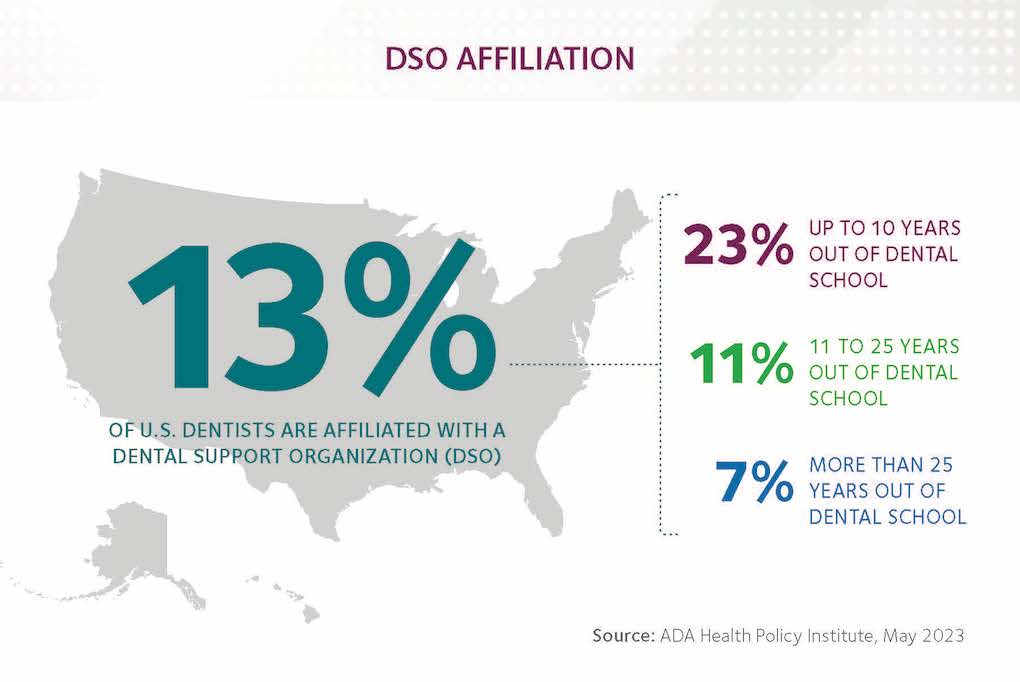
It’s no secret more dental practices are choosing to affiliate with dental service organizations (DSOs). In fact, recent data from the American Dental Association (ADA) Health Policy Institute (HPI) shows 13% of U.S. dentists have transitioned to some DSO format, a steady increase over previous years thanks to the consolidation wave taking place. More specifically, newer dentists are the ones leading the trend. Here’s what you can take away from this information and expect for the future of the industry as older dentists move toward retirement and others are looking to sell at an earlier age.
ADA graphic

How it breaks down

For dentists less than 10 years out of dental school, the rate of affiliation is as high as 23%, compared to 11% who are 11 to 25 years out of school and 7% who are more than 25 years removed. This means more dental school graduates are choosing to practice with DSOs rather than go through the process of starting up their own businesses as “practice modality continues to change,” said ADA Chief Economist and HPI Vice President Marko Vujicic, Ph.D.

What are the options

It used to be that dental school graduates only had the option to go into solo practice, associate with a private practice, enlist in military service or start a career in academia. Many dentists have yet to envision becoming a part of a DSO without an ownership benefit or management responsibility as part of their career path. This allows you to relocate or move among practices with ease and little stress since there is no real commitment on your end while being offered a full-time salary with benefits rather than hourly rate.
ADA graphic

Here’s the reasoning

More and more, dentists are looking to relinquish their managerial responsibilities in favor of clinical care. Those looking to enter the space are faced with high student loan costs, forcing recent graduates and even establish practice owners to look at different options other than a sole proprietorship. With changing demographics and a high regulatory environment, there is a lot more at stake for dental professionals to make sure they stay on top of all that is involved in running a successful practice.

Understanding the numbers

It’s a fact that dentistry is the number one job in America for debt. This puts even more pressure on dental school graduates to pick the proper transition route when entering into a practice. Although owning your own dental practice is the ultimate dream for most, between dental school and bank loans, you have the potential to be $1 million in debt before seeing your first patient. Yes, the success rate for dental practices is high, but working for a DSO upon graduation makes sense for a fledgling dentist to get their feet on the ground.

What’s next?

Choosing a transition option isn’t a cut-and-dry process. Contact the experts at Professional Transition Strategies to help navigate your next steps.

A New Way to Handle the Dental Staffing Shortage

dentist working on a patient

If one good thing came out of the pandemic, it’s that innovative ways were dreamed up to create remote work. Yes, teledentistry had its moment, but even now, dental professionals are finding ways to fill the gaps during the ongoing staffing shortage, one of the most notable fallouts that has even forced some dentists to consider selling their practices at an earlier age. Enter remote dental assistants. Here’s how hiring from outside your geographic area can open a new world of talent at your dental practice.

How we got here

Like the rest of the health care industry, dentists are still playing catchup after being forced to shut down for months on end. That time also led to an increase in dental services for an aging demographic and population growth, along with a greater focus on preventative care and treatment that couldn’t be delayed. What’s more, the Great Resignation gave space for professionals to reconsider their career choices. And for those looking to get into the dental field, they are faced with the education and training requirements, not to mention a competitive job market required to attract and retain skilled professionals. This has all led to increased wait time for patients and stress on current staff.

What can be done

An innovative way to solve this problem is to hire a virtual dental assistant who is skilled to handle a variety of tasks remotely. This includes answering the office phone, scheduling appointments, answering patient questions, coordinating insurance and patient treatment needs, and providing administrative support. All of this can be done from anywhere, anytime with the help of cloud-based dental practice management software and without the need for overtime pay or benefits associated with a full-time employee.

How this helps

The benefit of hiring a remote dental assistant can be a win-win since it opens up a pool of talent beyond your local area. You will also save on the costs associated with an on-site employee, such as office space, equipment and supplies. This level of efficiency means your dental practice will be able to see more patients in a shorter amount of time. In turn, your dental staff will be relieved of the stress associated with these managerial responsibilities and be able to provide higher-quality patient care and an overall better patient experience.

What’s next?

Finding ways to save time, money and stress while improving efficiency and accessibility can be a tough balancing act for dental professionals. Contact the experts at Professional Transition Strategies to learn more ways to keep your staff and patients happy and healthy.

Why Dentists Are Selling Their Practices at an Earlier Age

dental office

Even just a few short years ago, pre-pandemic, dentists were selling their practices when they were in their mid- to late 50s. These days, the average age is skewing toward 44 years old. This is thanks to two main factors, as Professional Transition Strategies M&A Advisor Troy Jones points out in a recent article for Dental Review News. Here are the key takeaways from his observations and how you can learn from the opportunities at hand.

DSO consolidation in the dental industry

The main driver in the desire to sell earlier is the rapid consolidation happening in the dental industry. In short, equity arbitrage has created wealth-building opportunities for those looking to sell their dental practices. Like other medical fields with specialty sectors, “The dental industry is also undergoing rapid consolidation as investors recognize the untapped value in the sector and its strength to endure adverse events, such as economic downturns,” Jones writes. This level of activity means more dentists are becoming aware of options beyond selling 100% of their practice to a partner and retiring, the only option that existed in past generations.

“Private equity–backed dental service organizations (DSOs) offer a wide range of choices, including full cash payouts or a partial cash payment combined with an equity stake,” Jones continues. “DSOs can deliver a jaw-dropping 60% to 80% average annual return on a relatively short recapitalization timeframe, e.g., two to five years.” This scenario allows younger dentists to continue working while rolling over their equity stake to potentially keep generating exponential returns that build generational wealth.

Pandemic challenges still in the dental industry

Dentists are still feeling the effects of the pandemic, the most notable being staffing challenges and operational fallout. It’s not all doom and gloom, however. “Financially, most dental practices rebounded strongly, with many practices achieving their best revenue totals ever in 2021,” Jones explains. “But administrative aspects of running a practice are more challenging now.” This includes a shortage of dental hygienists, in particular.

What’s more, dental education “is another pressure point for younger dentists,” Jones points out, noting it is “especially acute for highly trained health care professionals, including dentists.” This creates another opportunity for a dentist to sell their business to a DSO to unload their managerial responsibilities and focus on the clinical care for which they got into dentistry in the first place while securing their financial future at the same time.

What’s next?

Jones asserts, “Competition among DSOs may increase the likelihood that dentists with valuable practices will receive attractive equity arbitrage offers.” No matter the type of buyer interested in your dental practice, you shouldn’t go it alone. Contact the experts at Professional Transition Strategies, who recognize that all dental practice transitions are unique. Even dentists who aren’t planning to sell their practices should consider investing time in a free valuation because, “When opportunity knocks, it pays to know what’s on the other side of the door,” Jones concludes.

3 Types of Dental Practice Sellers Who Should Partner with DSOs

dentist looking down from a patient's point of view

It used to be that dental school graduates only had the option to go into solo practice, associate with a private practice, enlist in military service or start a career in academia. Many dentists have yet to envision becoming a part of a dental service organization (DSO) as part of their career path. But these days, the American Dental Association’s (ADA) Health Policy Institute (HPI) estimates 10% of dentists are affiliated with a DSO, a number that is steadily growing — and for good reason. So who is partnering with DSOs, and why? Here are the types of sellers who are choosing to hand over the managerial responsibilities of dentistry in favor of other employment opportunities.

Dentists looking to relocate

Whether you are relocating your dental practice across the street or across the country, relocating your dental practice is much more than just packing up your boxes and moving. In fact, it can change your patient demographics enough that it’s like starting your dental practice over from scratch. Rather than deal with all the considerations that go into relocating your dental practice, selling to a DSO could make logistical sense so you are joining up with an already-established practice to ensure a successful outcome for both your staff and patients without having to deal with the hassle of negotiating a lease.

Dentists looking to retire

Sure, you don’t need to be ready to retire to sell your dental practice to a DSO. As part of the consolidation trend, you can sell to a DSO and still practice at your original location, as long as clear lines are drawn. While affiliating with a DSO isn’t an option for everyone since each DSO has its own practice profile or requirements (including collections, number of ops, location and type of dentistry), you’ll get a higher valuation and be able to completely retire when the time comes. Specifically, DSOs can pay more than a single practitioner because they are funded by private equity groups, there is more variety of DSOs available from which to choose, and DSOs have the financial ability to compete in the bidding wars without set limits.

Valuating your dental practice before retirement is on the horizon will give you an idea of how much it’s worth and what you need to increase (production, collections or otherwise) in order to pay off your loan, if you have one. Not only will your practice value for more if selling to a DSO, but you also have the option to stay on and earn a salary for that inevitable retirement, unlike with a straight buy-out.

Dentists looking to clear up debt

Although owning your own dental practice is the ultimate dream for most, between dental school and bank loans, you have the potential to be $1 million in debt before seeing your first patient — in fact, it’s no secret dentistry is the number one job in America for debt. Yes, the success rate for dental practices is high, but working for a DSO upon graduation makes sense for a fledgling dentist to get their feet on the ground. Plus, there’s the added benefit of being able to focus on the clinical side of dentistry rather than deal with the managerial responsibilities that come with running a business.

What’s more, this allows you to relocate or move among practices with ease since there is no real commitment on your end. The same is true for established dentists who may be looking to take their practices to the next level and want to know what their business is worth. Either way, you likely added to your debt pile in an effort to hone your clinical skills or made some personal sacrifices to grow your business along the road to profitability, and affiliating with a DSO will help to alleviate your stress while taking care of debt.

What’s next?

There are countless reasons to consider affiliating with a DSO, and you shouldn’t have to go it alone. Contact the experts at Professional Transition Strategies to see if you’re a good fit.

Top 5 Dental Practice Transition Searches in 2022

person getting dental work

Whether you’re looking to buy or sell a dental practice, chances are, you’ve turned to your search engine to figure out where to start. Well, we’ve done the research for you to help point you in the right direction. Read on for the top search results for dental practice transitions, then where to go from there.

“What is a dental practice transition?”

Maybe you’ve probably already decided that selling your dental practice is the best option at this point in your career, whether it’s for retirement or managerial purposes. But if you don’t know or haven’t started exploring all your options yet, it’s time to work with a dental practice broker to learn the different types of dental practice transitions, each of which comes with its own set of factors and timeframes. There’s no one way to ensure a successful transition of ownership but a professional broker can help answer all your questions.

“What are the current trends in dentistry?”

The past two years have certainly had their ups and downs with so much unpredictability during unprecedented times, but in the world of the dental industry, there are a lot of trends and technology to keep up with. If you haven’t already explored augmented reality, artificial intelligence or 3D printing at your dental practice, now is the time. One trend that isn’t going away anytime soon: dental service organization (DSO) consolidation. Yes, DSOs are always increasing in popularity, but when the pandemic forced many established dentists to consider early retirement, it paved the way for a new generation. The practices that are being bought up and sold to DSOs are making it more affordable for dental school graduates to focus their efforts on attracting new patients and offering the latest technology.

“What makes a dental practice profitable?”

If you’re still following the business model you established for your dental practice 20 years ago, you’re missing countless opportunities to increase your profits. General inflation, your current patient base and your competition are just a few reasons why it’s important to focus on the “now” of your dental practice. It all comes down to cutting overhead costs, preparing for an inevitable transition of ownership, how you train your staff, and establishing a plan to grow your services and practice in the long run.

“How can I make my dental practice stand out?”

In a competitive environment, it can feel like bigger dental practices have bottomless marketing budgets. In order to grow your business, a smart tactic can be to look at other industries for ideas and inspiration. Personalized marketing and online efforts are just scratching the surface of how you can reach new patients. One specific area to look at is your website. Above all, your website should answer questions upfront and be marketed appropriately. Rather than trying to add this task to your already-full plate, a professional marketing company can make the technology work for you. And, in a completely different direction, don’t discount the impact your dental practice can have in giving back to your local community.

“How do I transition my dental practice to a DSO?”

It would be seemingly impossible to begin the process of selling your dental practice without considering DSO. Sure, any good dental practice broker will point out the advantages and disadvantages of selling to a DSO. But even if you are sold on the idea of affiliating with a DSO, there are some considerations you’ll need to take into account first. A professional broker will walk you through the different types of DSOs, what DSOs look for when purchasing dental practices, why DSOs can pay more for a dental practice than a single practitioner and even the reasons to sell your dental practice to a DSO if you’re not yet ready to retire.

What’s next?

Only time will tell what 2023 has in store for the world of dental practice transitions. Contact the experts at Professional Transition Strategies to start the new year off on the right foot.

How a Dental Practice Broker Can Help with the Pre-qualification Loan Process

dental image

As if starting a new dental practice isn’t overwhelming enough. Whether you’re just out of dental school and trying to juggle student loans or transitioning ownership after years of practicing, it’s easy to get lost in the weeds leading up to the pre-qualification process for a business loan. That’s where a dental practice broker comes in. Here’s how a dental practice broker can hold your hand throughout the pre-qualification process. 

Know where to start

The harsh reality is that the average dental student will graduate with $570K in debt. Rather than starting as an associate or even working for a dental service organization (DSO) after graduating with a negative net worth, the fastest way to make dentistry worth it is through practice ownership. Though counterintuitive, taking on more debt will pay off. A dental practice broker will help ensure your investment is typically paid back within eight years of practice.

Ask the right questions

Applying for any type of loan has its challenges, never mind a loan to start a dental practice. And with any new ventures, there are a lot of unknowns with which come a set of questions. A dental practice broker will help point you in the right direction when it comes to knowing if you’ll qualify for a dental practice loan, which banks to approach and how they differ, and ways to ensure you’ll be approved.

Get a better deal

There’s room for negotiation in every step of the dental-practice-buying process, including when shopping for a business loan. A low-interest rate, low fees, favorable payment schedule, and flexible or no-collateral security will all significantly enhance the benefits of your business loan. A dental practice broker will help you get a better deal on your business loan when purchasing a dental practice, including shopping for the best options and choosing the type of lender.

Know what to look for

A dental practice broker knows a relationship has to work both ways when it comes to working with a lender. Not only will you want to work with the lender you feel most comfortable and not necessarily who offers the lowest price for their services, but a lender will likewise be selective when looking to award your practice a loan. Your lender should have a strong understanding of the industry, as well as the ability to judge high-quality practices.

Know your numbers

Above all, it’s important to know where you stand financially. Surprisingly, personal debt doesn’t weigh much into the bank’s decision of lending to dentists, but you’ll still want to have a strong history of making payments on time and be aware of your credit score. Part of knowing where you stand is working with a proper team to get all your paperwork lined up. A dental practice broker works with a network of dental-specific advisors who can help navigate the process leading up to a smooth transition to dental practice ownership.

What’s next?

Contact the experts at Professional Transition Strategies for more ways to navigate dental practice ownership throughout the process.

What New Dentists Need to Know to Grow Their Practices

dentist working on a patient

Starting a new dental practice can be overwhelming, and rightfully so. Whether you’re just out of dental school or transitioning ownership, you’re probably finding out there’s more to practice ownership than clinical work. But how do you get settled into your new dental practice for future growth and to improve its value? Here, we detail the best path forward on your road to dental practice ownership as part of the effort to maintain attrition rates and attract new patients.

Open lines of communication

One of the top qualities patients admire in a dentist is honesty. This is especially true when it comes to being well-informed about procedures that need to be done. If a patient doesn’t feel comfortable about a decision that needs to be made, they may experience hesitancy about oral care going forward. What’s more, dental staff needs to be transparent about pricing for these procedures, including whether they’re in- or out-of-network. 

Remain focused

It can be easy to get 10 steps ahead of yourself when dealing with a patient load for the day. The best thing you can do for both you and the patient is to focus on them and any issues that arise when you’re in the moment. The last thing a patient wants to feel is rushed through their appointment so they don’t have the chance to ask any questions they may have. Better yet, asking about any oral health problems they’ve had in the past without any judgment. A relationship of dignity and respect starts as soon as patients walk in the door.

Keep in touch

Above all, it’s important for patients to see the need for regular dental care. Make them feel comfortable from their first interaction with your office, including setting expectations for what will happen at their appointment. Do your best to set a schedule and stick to it for your sake and the patients’. And, if your office isn’t already operating digitally, it’s high time you consider switching to a cloud-based software management system.

What’s next?

Contact the experts at Professional Transition Strategies for more ways to keep your dental practice on top of its game throughout the course of your ownership.

How Dental School Debt Compares to Medical School Debt

dentist looking at x-ray

It’s no secret that dentistry is the number one job in America for debt. This puts even more pressure on dental school graduates to pick the proper transition route when entering into a practice, whether that’s buying an existing dental practice or starting from scratch. However, when it comes to your return on investment, the differences between dental and medical school debt are night and day. Here, we present the data and explain why taking on dental school debt pays off in the long run. 

The average debt for a dental student was $292,169 in 2019 while medical students owed about $215,900 in 2018, the last year data was available. 

New dental school graduates are in a good position to establish a startup with profitability projected between six and nine months. You’ll have full control over the design and aesthetics of your practice to the types of patients and procedures you attract, as well as the scale of your practice based on your skill set. There is also an attrition rate of between 15% and 20%, compared to an existing practice in which you can expect a profit from day one but an expected 7% to 10% of the existing patient base to leave after the transition.

Rather than taking the safer route of working as an associate or for a dental service organization (DSO) that will only provide a commission for the work you do, owning your own practice will only maximize the investment of your dental degree because you’ll receive not only a commission, but also a profit component, most notably in an area where there is demand. Though counterintuitive, taking on more debt will pay off as your investment is typically paid back within eight years of practice. Yes, your debt rate will be high before you even see your first patient, but so is the success rate. You should expect a couple of lean years since it can take a while to get the same revenue as if you bought an existing practice. 

The average cost of a four-year dental education was $205,019 for public schools and $335,536 for private schools in 2019–20, the last year data was available. The average yearly cost of medical school for non-residents in 2019–20 was $61,620 for public schools and $60,305 for private schools. 

It may be surprising to know that lenders are not necessarily worried about student loan debt. The reason is that it is widely acknowledged that dental school graduates have a significant amount of student loans so the default rate for dental practices is low. What the banks will look at is if the doctor can afford the payments on the student loan debt and the practice debt.

Compared to a small business owner whose average salary is approximately $70,000 a year, as of 2016, the average dentist’s salary is $173,000, the average orthodontist’s salary is $228,000, and the average oral and maxillofacial surgeon’s salary is $233,000. Due to the higher-than-average annual salary and the 0.3% failure rate of dental practices, the dental industry has the lowest default rate and some of the highest cash flow.

Average dental student debt was $58,603 in 1980, adjusted for inflation, and $292,169 in 2019, the last year data was available. Average medical student debt was $84,300 in 1988, adjusted for inflation, and $215,900 in 2018, the last year data was available.

There are seemingly endless options for refinancing your dental school debt, all worth exploring related to your personal and professional financial situation. Then, start any new business opportunity with the end in mind by knowing what types of transitions are available to you. What’s more, even once you’re established in the practice, you’ll want to brush up on your skills or learn new ones, not limited to dental classes to better your business opportunities. 

What’s next?

Contact the experts at Professional Transition Strategies to guide you through the dental practice ownership process. 

How a Buyer Can Find the Perfect Dental Practice

dental tools

Whether you’ve graduated dental school and are finally ready to purchase your first dental practice or are a seasoned veteran looking to expand your portfolio, the process of buying a dental practice is a labor of love. Like the purchase of a home, you’ll want to make sure it’s a good fit for all the right reasons. Here, we help you get a leg ahead when it comes to buying the perfect dental practice for you. 

Assess your situation

Before diving in to the buying process, you’ll want to take a look at your specific financial and personal situation, starting with compiling a dental practice checklist. If making money from day one is your priority, then you’ll want to consider purchasing an existing dental practice rather than starting one from scratch. Going through a proper valuation process and getting prequalified will ensure you know what you’re getting into from the outset.

Avoid mistakes

It can be easy to let your adrenaline take over when you’ve made the decision to purchase a dental practice. Even if you’re eager to jump right in and get things started, there are some key mistakes you’ll want to avoid in the beginning, including purchasing the first dental practice you see, entering a new partnership and getting set on a plan when there are so many different transition options out there.

Work with a broker

Though you may be eager to jump right in and get things started, working with a qualified dental practice broker, like Professional Transition Strategies (PTS), will help take the emotion out of the transaction to ensure you’re selecting the best possible fit for your personal and professional life. Let a broker assemble a team of advisors to support you throughout the process. Your time is better spent focusing on your new life goals.

Set up a buyer profile

You can certainly browse dental practices for sale online, but creating a buyer profile on PTS’s website will notify you of new dental practices as soon as five days sooner than anyone else. You’ll be able to dial in on the type of dentistry you practice, states of interest with specific cities and towns, size of desired practice, number of operatories and even the type of transition, all in an effort to truly find the perfect fit for you and your future.

What’s next?

Contact the experts at PTS to get one step closer to owning the dental practice you’ve always envisioned.

Why Continuing Education Matters In Your Dental Practice

Your return on your dental school investment has already paid off, but unless you’re brushing up on your skills or learning new ones, you’re missing an opportunity to better your dental practice. But furthering your skills isn’t limited to dental classes. Here are other ways to approach your continuing education.

What to know

The world of dentistry is ever-evolving as technology changes. In fact, every state requires some level of mandatory continuing education to maintain a dental license. From artificial intelligence (AI) to augmented reality (AR), it’s important to keep on top of all the dentistry trends that could make your dental practice stand out from the rest.

What to balance

Any dentist knows owning a practice is more than just clinical work. Yes, it’s important to expose yourself to new aspects of dentistry and clinical education, but you should also be focusing your efforts on business leadership, customer service, and sales and marketing in an effort to help you better run the practice, implement new systems and lead your team to success. Commit to reading one book on business management or taking a webinar on leadership or team development to streamline your practice and train and retain staff to support it.

Stay in the know

It’s never too early to think about what path you want your dental career to head down. If you are just getting started in your career as a dentist or a dental specialist, make sure you have all the information you need to get started on the right foot, starting with a free e-book for dental school graduates. Alternatively, if you are wondering how your life could be different if you made another decision along the way, check out a choose-your-own-adventure-style e-book.

What’s next?

Contact the experts at Professional Transition Strategies to learn more ways to keep your dental practice on top of its game.